The TESS space telescope has spotted its first exoplanet0
- From Around the Web, Space
- September 20, 2018
Pi Men c’s size and mass suggest it may have lots of water

Pi Men c’s size and mass suggest it may have lots of water
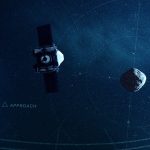
After an almost two-year journey through space, NASA’s Origins, Spectral Interpretation, Resource Identification, Security-Regolith Explorer (OSIRIS-REx) caught its first glimpse of Bennu, a carbonaceous asteroid whose makeup may record the earliest history of our Solar System, last week and began the final approach toward the asteroid. Using its multipurpose PolyCam camera, the spacecraft obtained the image of Bennu from a distance of 1.4 million miles (2.2 million km), or almost six times the distance between the Earth and Moon.
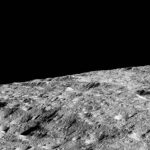
We usually associate volcanoes with extreme heat. But new results demonstrate that the Solar System’s largest asteroid, Ceres, is covered in volcanoes that have spewed ice throughout their history.
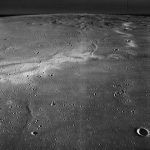
Planetary researchers from Rutgers University and the University of California, Berkeley may have solved the mystery behind lunar swirls, wispy bright regions scattered on the Moon’s surface. The solution hints at the dynamism of the Moon’s ancient past as a place with volcanic activity and an internally generated magnetic field.
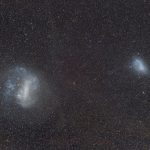
Two of the closest galaxies to the Milky Way — the Large and Small Magellanic Clouds — may have had a third companion, astronomers believe. New research describes how another ‘luminous’ galaxy was likely engulfed by the Large Magellanic Cloud some three to five billion years ago.
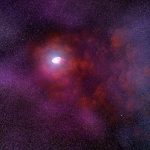
An unusual infrared emission from the neutron star RX J0806.4-4123 detected by the NASA/ESA Hubble Space Telescope could indicate new features never before seen: one possibility is that there is a disk of material surrounding the neutron star; another is that there is an energetic wind coming off RX J0806.4-4123 and slamming into gas in interstellar space the neutron star is plowing through.
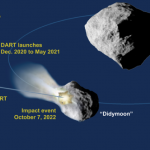
A mission to deflect asteroids that might threaten Earth has begun its final design and assembly phase, according to a news release.
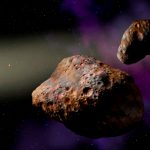
A strange pair of space rocks twirling around each other as they orbit the sun has helped scientists pinpoint when our solar system developed its current formation.
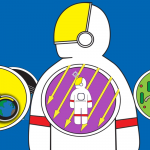
A human journey to Mars, at first glance, offers an inexhaustible amount of complexities.
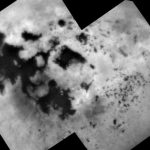
During NASA’s Cassini mission’s final distant encounter with Saturn’s giant moon Titan, the spacecraft captured the enigmatic moon’s north polar landscape of lakes and seas, which are filled with liquid methane and ethane.