Why some physicists really think there’s a ‘mirror universe’ hiding in space-time0
- From Around the Web, Science & Technology, Space
- June 24, 2020
What happens if you turn space-time upside-down?

What happens if you turn space-time upside-down?

Billionaire Richard Branson’s Virgin Galactic Holdings Inc (SPCE.N) said on Monday it has signed up with NASA to develop a program to promote private missions to the International Space Station (ISS), sending the shares of the company up about 16%.
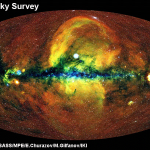
Behold the hot, energetic Universe.
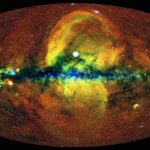
A new all-sky image from the eROSITA X-ray telescope onboard the Spectrum-Roentgen-Gamma (SRG) space observatory contains over one million objects, about half of which are new to astronomers.
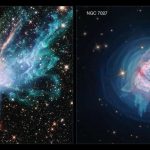
Two stunning images captured by the Hubble Space Telescope show layers of gas and dust as they eject, swirl, and interact between two nebulas known as NGC 6302 and NGC 7027.
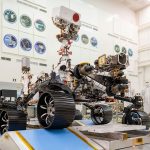
The Red Planet’s surface has been visited by eight NASA spacecraft. The ninth will be the first that includes gathering Mars samples for future return to Earth.
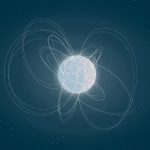
Using NASA’s Neil Gehrels Swift Observatory, ESA’s XMM-Newton observatory, NASA’s Nuclear Spectroscopic Telescope Array (NuSTAR), and ground-based telescopes, astronomers have detected a hard X-ray burst, a long-lived outburst and a number of strong and short radio pulses from an infant neutron star with a magnetic field some 70 quadrillion times stronger than that of Earth. Named Swift J1818.0-1607, the object emitted X-rays about 16,000 years ago, when it was about 240 years old.

Streams of plasma shooting away from galaxies flare at the ends

Signal from 500 million light years away is the first periodic pattern of radio bursts detected

Using data from NASA’s Kepler/K2 mission, the SPECULOOS telescopes and the High Resolution Echelle Spectrometer (HIRES) on the Keck I telescope at W.M. Keck Observatory, astronomers have discovered a transiting Earth-sized planet in a close-in orbit around the red dwarf EPIC 249631677.