
‘Mini-Neptunes’ beyond solar system may soon yield signs of life0
- From Around the Web, Space
- August 30, 2021
Cambridge astronomers identify new hycean class of habitable exoplanets, which could accelerate search for life

Cambridge astronomers identify new hycean class of habitable exoplanets, which could accelerate search for life

Science and technology ministry’s funding arm proposes five-year project on building ‘ultra-large spacecraft’ to aid exploration and stay in long-term orbit

We rely on experts all the time. If you need financial advice, you ask an expert. If you are sick, you visit a doctor, and as a juror you may listen to an expert witness. In the future, however, artificial intelligence (AI) might replace many of these people.

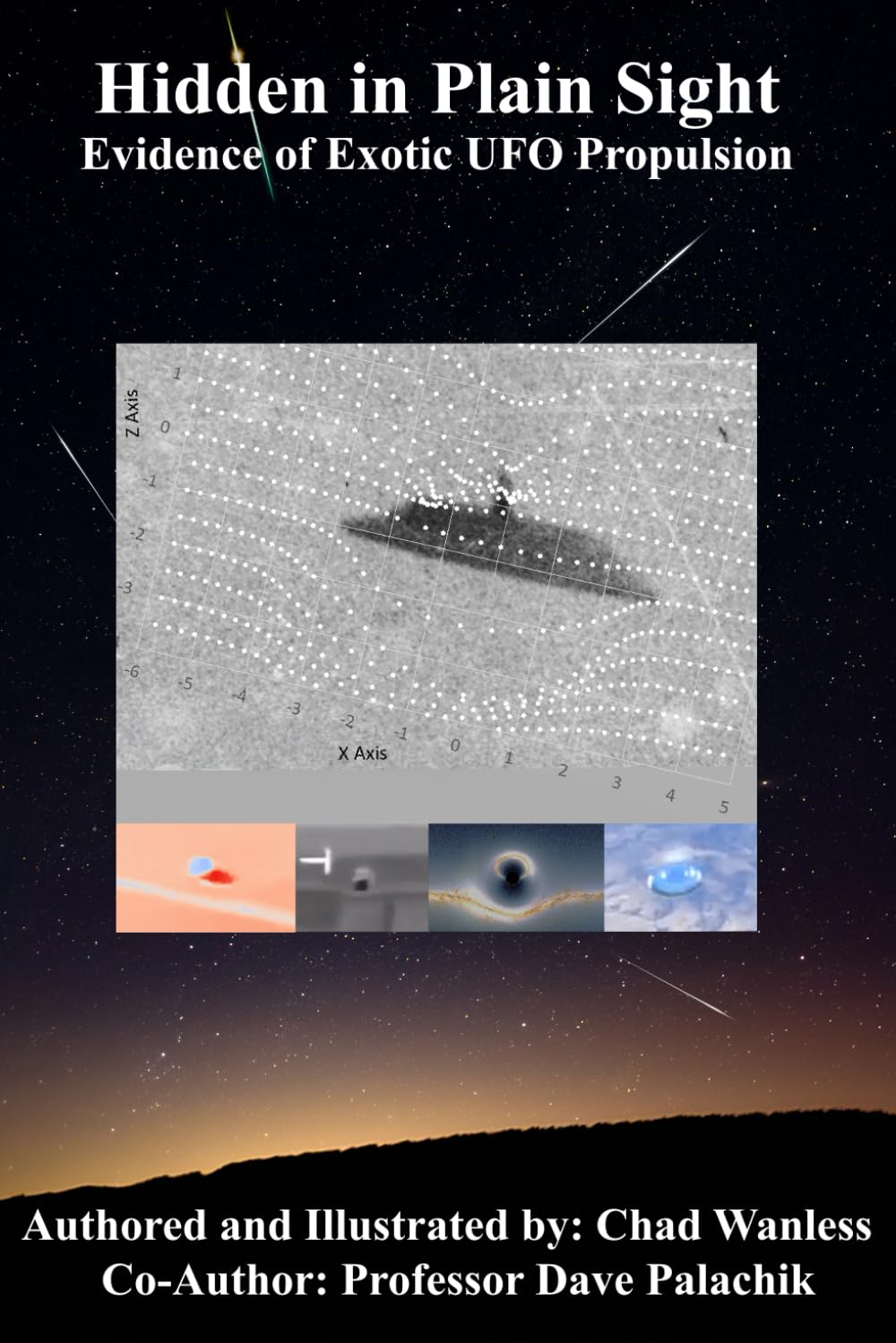
View that some UFOs are alien spacecraft is up eight points since 2019

Our solar system is home to some unusual places we could potentially migrate to if Earth were to die.

But first, a holiday while Mars is on the other side of the Sun

No hate to the Greek philosopher, but he wasn’t the first to use Pythagorean triples.

The recent detection of 2I/Borisov, the first known interstellar comet to visit our Solar System, implies that interstellar objects outnumber the non-interstellar ones in the Oort Cloud, whereas the reverse is true near the Sun due to the stronger gravitational focusing of bound objects, according to a new paper authored by Harvard & Smithsonian’s Center for Astrophysics astronomers Amir Siraj and Avi Loeb.

A new book tells the history of George Gamow, Fred Hoyle and the origin of the universe

The newly-discovered asteroid 2021 PH27 has a diameter of about 1 km (3,280 feet) and orbits the Sun in just 113 days — the shortest known orbital period for an asteroid and second shortest for any object in our Solar System after Mercury.