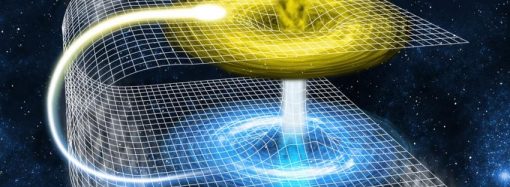
What Does a Black Hole Really Look Like?0
- From Around the Web, Space
- April 20, 2017
39-year-old drawing hints at what the Event Horizon Telescope may have just captured: the true shape of a black hole

39-year-old drawing hints at what the Event Horizon Telescope may have just captured: the true shape of a black hole
Enceladus is ripe for life. In one final pass through the icy moon’s liquid plumes, NASA’s Cassini spacecraft found molecular hydrogen, which indicates favourable conditions for life in Enceladus’s subsurface sea.
The United States Navy fired a projectile at Mach 6 during a recent test with an electromagnetic railgun, suggesting that early ideas about using such tech to launch payloads from the lunar surface might not be so sci-fi after all.
New research suggests that active volcanoes on the Red Planet could have created an environment habitable to ancient microbes.
Researchers at the University of Waterloo have been able to capture the first composite image of a dark matter bridge that connects galaxies together. The scientists publish their work in a new paper in Monthly Notices of the Royal Astronomical Society.
A new study pursues a kind of “paleontology” for gravitational waves in an attempt to explain how and why black holes collide and merge.
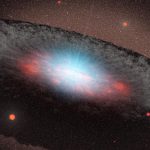
Astrophysicists at the University of Birmingham have made progress in understanding a key mystery of gravitational-wave astrophysics: how two black holes can come together and merge.
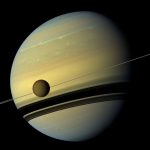
“Titan’s extreme physical environment requires scientists to think differently about what we’ve learned of Earth’s granular dynamics,” said Josef Dufek, with the Georgia Institute of Technology. “Landforms are influenced by forces that aren’t intuitive to us because those forces aren’t so important on Earth. Titan is a strange, electrostatically sticky world.” Visually, Titan is the
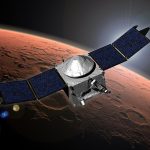
Mars’s atmosphere harbours a layer of electrically charged metal atoms, and they’re not behaving as expected.
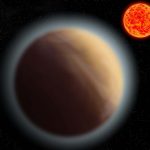
An Earth-sized planet orbiting a dim star 39 light years away has a hazy atmosphere that could indicate the presence of a “water world”.