Excerpt from Claude Limberger’s book “Johnny’s Ripple”0
- Another Point of View, Featured Articles
- January 13, 2017
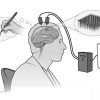
Then, quite suddenly, he left his body.
He felt no fear, but saw himself frozen in mid grab, reaching for the cup.


Then, quite suddenly, he left his body.
He felt no fear, but saw himself frozen in mid grab, reaching for the cup.

A newly proposed technique could make it possible to search for life on alien planets much sooner than scientists had expected.
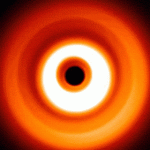
Searching for planets around other stars is a tricky business. They’re so small and faint that it’s hard to spot them. But a possible planet in a nearby stellar system may be betraying its presence in a unique way: by a shadow that is sweeping across the face of a vast pancake-shaped gas-and-dust disk surrounding a young star.

Every few thousand years, an unlucky star wanders too close to the black hole at the center of the Milky Way. The black hole’s powerful gravity rips the star apart, sending a long streamer of gas whipping outward.
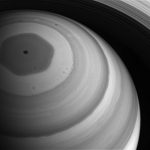
Sunlight truly has come to Saturn’s north pole. The whole northern region is bathed in sunlight in this view from late 2016, feeble though the light may be at Saturn’s distant domain in the solar system.
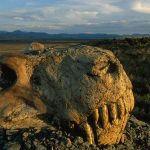
A quarter of a billion years ago, long before dinosaurs or mammals evolved, the 10-foot (0.3-meter) predator Dinogorgon, whose skull is shown here, hunted floodplains in the heart of today’s South Africa. In less than a million years Dinogorgon vanished in the greatest mass extinction ever, along with about nine of every ten plant and animal species on the planet.
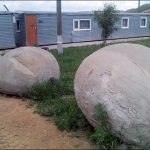
Found 30 metres underground at a coal mine, they are dubbed Jurassic pearls or the marbles of a Siberian colossus. The ten spheres are around half the size of a human, a metre or so in diameter, and almost perfectly round and smooth. To add to the mystery, they change color after rain. What are they?
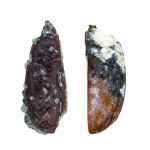
Fossilised forewings from two individuals, discovered on the Beardmore Glacier, revealed the first ground beetle known from the southernmost continent. It is also the second beetle for the Antarctic insect fauna with living descendants.
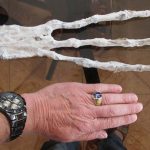
A mummified three-fingered hand with eight inch fingers has been found in a Peruvian tunnel in the desert.

2016 has revealed an amazing array of archaeological discoveries, pushing the boundaries of scientific research and our understanding of the past. The following list represents 10 of the most exciting announcements across the year.